
How Arrest Warrants Work in Mitchell County
An arrest warrant is a judge's order letting law enforcement take a named person into custody. In Mitchell County, the clearest local description of the process starts with a report to the agency with jurisdiction. The applicant gets an incident report, completes a warrant application, and presents the matter to Magistrate Court. From there the judge may grant it, deny it, or set a hearing. That order starts criminal process under the issuing court's authority. Superior Court handles felonies, State Court handles misdemeanors, and Magistrate Court reviews many applications, while the sheriff serves county warrants.
Mitchell County Arrest Reports First
The official Mitchell arrest-warrant handout tells private applicants to get an incident report first. Accuracy matters, so names, physical addresses, dates, and times need to be right, since the report itself may be incomplete or wrong. A complete application still does not guarantee issuance. The court can deny a request for weak evidence, lack of credibility, no crime, or frivolous purpose. It may also schedule a hearing and notify other parties. That screening is why an application, a hearing, and an issued warrant are three different record states in Mitchell County.
Mitchell County Arrest Warrant Contents
A Mitchell County warrant file can hold an incident report, the offense, the applicant, the sworn date, the judge, the result, and clerk processing. If the warrant issues, the file may add a case identifier, issue date, the accused's matching details, service status, bond condition, and later outcome.
| Identity | Name, address, and matching details |
|---|---|
| Allegation | Offense and incident-report facts |
| Court | Issuing judge and court |
| Decision | Granted, denied, or hearing set |
| Status | Issued, served, recalled, or disposed |
| Conditions | Bond and appearance terms when public |
Mitchell Arrest Warrant Fee Facts
The Magistrate cost sheet lists a $20 warrant-application fee in Mitchell County. The handout says the $20 stays due even if the judge declines to issue the warrant. Family and domestic-violence applications are free. This is not a clearance fee, a bond, or payment for a favorable ruling.
Process boundary: A private complainant cannot simply drop a signed criminal warrant. The court and prosecutor control the case.
The Mitchell County handout also warns against false reports, false swearing, punishment, and using criminal process to collect a debt.
How Warrants Get Served in Mitchell County
The Mitchell County Sheriff's Office is the countywide service channel. Municipal police and other agencies may also act within their own authority. Service can happen through direct contact, another lawful encounter, or a planned surrender, and no official source promises notice first. The current sheriff number is 229-336-2030. An older county page lists Warrants/Civil at 229-336-2033, so use the current line and ask for that function. After an arrest, booking, a first appearance, bond review, and transfer to the proper trial court may follow.
Mitchell Arrest Warrant Lookup Channels
Neither Georgia nor Mitchell County posts a public arrest-warrant portal. Georgia points people to the sheriff where the warrant originated. Have a full name and date of birth ready, and ask whether phone confirmation is offered or whether you must show ID in person. Keep in mind that custody may follow confirmation.
- Sheriff: 229-336-2030.
- Magistrate criminal desk: 229-336-2077.
- Superior and State Court Clerk: 229-336-2021.
- Municipal matter: call the city court named on the record.
Case-access providers and narrow Open Records Act requests can supply some Mitchell County records. Neither one is a complete live-warrant search.
Mitchell County Warrant Types Compared
An arrest warrant authorizes custody after judicial review. A summons orders appearance without being a custodial order. A bench warrant usually follows a missed duty in an existing case, and the Mitchell bench-warrant record route explains that separate process.
| Feature | Arrest Warrant | Summons | Bench Warrant |
|---|---|---|---|
| Order | Arrest | Appear | Return to court |
| Basis | Alleged offense | Complaint or citation | Missed court duty |
| Issuer | Judge or magistrate | Court or officer | Case judge |
| Response | Surrender and bond | Appear as directed | Recall, quash, or appear |
Mitchell County Arrest Warrant Review
The Magistrate Court page lists criminal warrants, applications, application hearings, arraignments, and good-behavior bonds. A Mitchell County application may end in a grant, a denial, or a hearing. An incident report supports review but is not itself a warrant. That page identifies the local criminal-warrant hearing route.
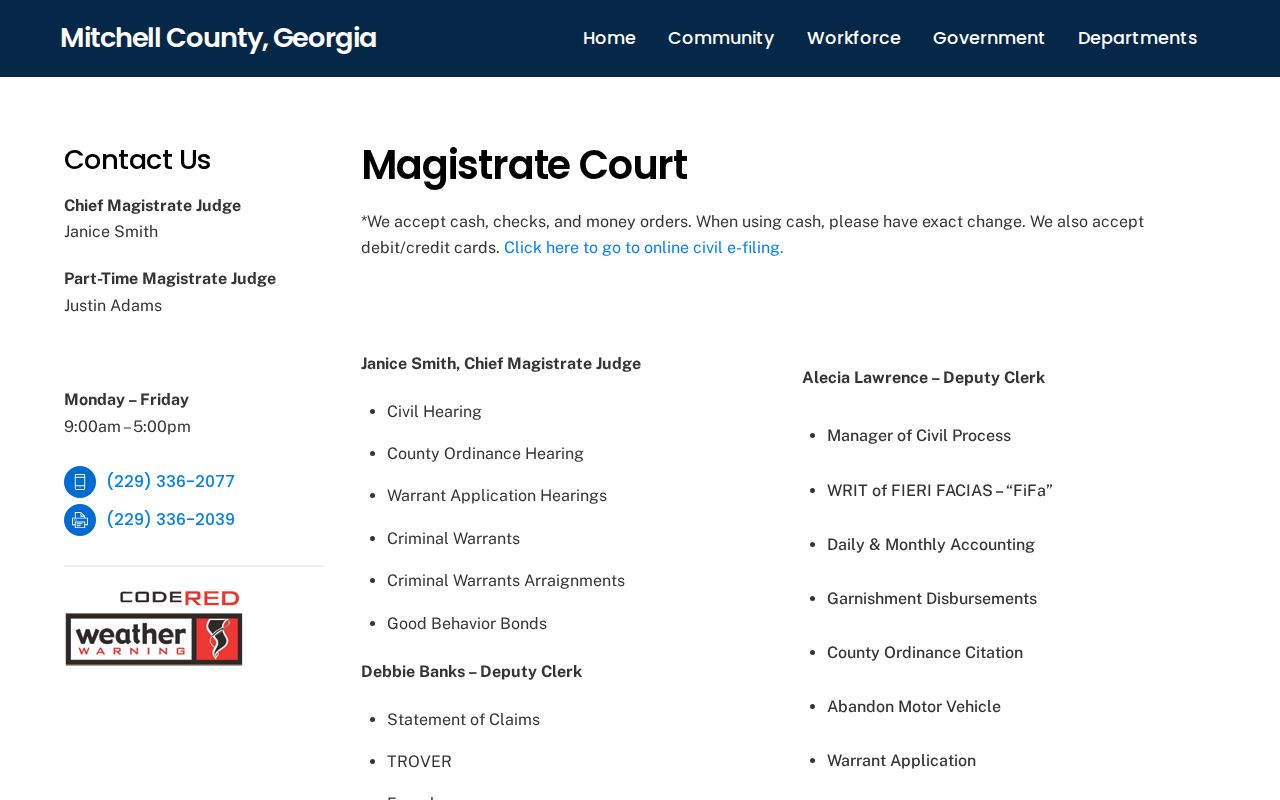
That Mitchell County court source beats an unofficial roster, because it names the office that handles applications.
Handling an Arrest Warrant in Your Name
Confirm the warrant, the issuing court, its current status, and any set bond through official channels. A Georgia criminal defense attorney can advise on voluntary surrender, first appearance, and whether a recall or quash motion is available. A private complainant cannot simply cancel the order.
- Speak with counsel.
- Verify the court, warrant, and bond.
- Arrange surrender or appearance as directed.
- Complete booking and bond steps if eligible.
- Keep the next date and written disposition.
Important: An active arrest warrant may be served without warning. Counsel can help coordinate a controlled surrender and court appearance.
Mitchell County Arrest Warrant Access
Georgia's Open Records Act opens a lot of doors, but not all of them. Sealing rules, active-investigation exemptions, protected identifiers, and juvenile confidentiality still block certain files. In Mitchell County, the Clerk handles public access to court records, while the sheriff and the Magistrate Court each control a different piece of the warrant process. Ask for something specific. Name the case, the date, the court, or the record you want rather than asking for a full roster. A name alone is a weak match. Similar names can point to entirely different people in Mitchell County, and a court calendar proves nothing about warrant status. Whatever copy you obtain, check it against the originating court or sheriff before you rely on it, because a copied record can lag behind a later judicial change.
Where you look depends on how the matter started. A city police department may hold the incident report. Magistrate Court may hold the application, the hearing notice, and the judge's decision. The sheriff handles warrant service and custody questions for Mitchell County. Once a case reaches Superior or State Court, its records route through the Clerk. That split explains why one phone call rarely answers everything, and why a missing result in one source does not prove that no warrant exists. The South Georgia Judicial Circuit publishes Mitchell County calendars, but a calendar lists scheduled court business, not a complete warrant list. Georgia Courts also names electronic case-access providers for Mitchell Superior and State Court. Provider accounts, document coverage, and update timing all vary. A newly issued, sealed, juvenile, or agency-held warrant may not show up in ordinary case access at all. For current status, the safest route is still direct confirmation with the issuing court and the sheriff.
A written Open Records Act request works best when you identify the agency, the approximate date, the incident or case number, and the exact record sought. The Attorney General's guidance notes that an agency may charge permitted search and copy costs, and it must cite its basis for withholding anything exempt. A records request suits an accessible copy or a disposition. It is not an emergency warrant lookup. It also does not replace surrender or bond instructions from the court. Mitchell County's official handout draws its own firm line between an application and an issued warrant. A $20 application fee starts the review and stays due even if the application is denied, apart from the documented family and domestic-violence exemption. That fee does not buy issuance, satisfy bond, or clear a warrant. A hearing can happen when credibility or the evidence needs more review, so describe each record by its actual stage.
After any surrender or court appearance in Mitchell County, hold onto the booking record, the bond paperwork, the next court date, and the written disposition. If the judge recalls or quashes an order, ask the court for proof. A web entry vanishing, a private complainant's verbal statement, or a calendar change does not by itself document judicial action. The originating court's record controls what happened to its own order.
Note: Mitchell County publishes no official active-warrant or most-wanted roster.