
How Bench Warrants Work in Mitchell County
A bench warrant is a judge's response to a missed court duty in an existing case. In Mitchell County, the clearest documented trigger is failure to appear for a scheduled criminal or traffic setting. Noncompliance with another direct court order may also cause the judge to act. The local sources do not publish a master list of triggers or promise a warning period. A person should read the actual docket, notice, or citation instead of assuming that a late payment and a missed appearance have the same result.
The warrant authorizes law enforcement to bring the person before the court. It does not create a new finding of guilt. Mitchell County publishes court calendars and direct contacts, but no public bench-warrant roster was found. That makes court identification the first useful task. The Superior Court of the South Georgia Judicial Circuit, Mitchell County State Court, Magistrate Court, and municipal courts control their own orders.
Mitchell County Bench Warrant Checks
There is no one public Georgia warrant portal and no official Mitchell County active-warrant list. Start with the Mitchell County Sheriff's Office contact page and call 229-336-2030 for the current Warrants/Civil route. An older county service page lists 229-336-2033. Because the newer source uses the main number, explain that the call concerns Warrants/Civil and let staff transfer it.
- For Superior or State Court records, call the Clerk at 229-336-2021.
- For a Magistrate criminal matter, call 229-336-2077.
- For traffic or misdemeanor settings in State Court, the court line is 229-336-2040.
- For a city matter, contact the municipal court named on the notice.
A narrow Georgia Open Records Act request can ask the agency holding a specific record for inspection or copies. It is not an instant warrant-status search. Georgia's state guidance warns that an in-person confirmation may lead to custody when an open warrant exists.
Bench Warrant Issuance in Mitchell County
The judge first determines that a required appearance or other obligation was not met. A calendar entry alone does not prove that a bench warrant issued. The South Georgia Judicial Circuit calendars show scheduled court business, not outstanding warrant status. The actual case record and issuing court's instructions control.
If the judge issues a warrant, it remains a court order until the court recalls, quashes, or otherwise disposes of it. The sheriff serves warrants but does not cancel a judge's order. Georgia materials reviewed use “bench warrant,” “failure-to-appear warrant,” “arrest warrant,” or simply “warrant.” They do not center the term “capias pro fine” for Mitchell County. Ask staff to explain the exact label on the record.
Missed Mitchell County Warrant Date
If you missed a setting, act before guessing what happened. Find the citation, bond paper, calendar notice, or case number. Note the court name and date. Then call that court and ask whether the judge entered a bench warrant, whether another date is available, whether counsel may file a recall or quash request, and whether an in-person appearance is required.
- Confirm the court and case identifier.
- Ask the clerk for the present case and warrant status.
- Ask whether bond or surrender instructions exist.
- Request proof when the court resolves the matter.
Do not rely on the absence of a name from a web page. Mitchell County has no official public roster in the reviewed sources. A city case may also remain with its own municipal court rather than appear in county court records.
Note: Call before visiting because the proper destination may be the courthouse, Magistrate Court, a city court, or the Justice Center.
Mitchell County Warrant Types Compared
Both are judicial orders, but they start differently. A bench warrant usually follows nonappearance or noncompliance in a case already before a judge. An arrest warrant rests on a judicial finding tied to an alleged offense. Mitchell Magistrate Court documents a separate incident-report-first application process for many arrest warrants. The companion Mitchell County arrest warrant explanation covers that local path.
| Feature | Bench Warrant | Arrest Warrant |
|---|---|---|
| Trigger | Missed setting or court noncompliance | Required legal basis for an alleged offense |
| Issuer | Judge handling the case | Judge or magistrate after review |
| Record path | Existing court file | Warrant application and criminal file |
| Next step | Appearance, recall, or quash | Surrender, bond, and first appearance |
Mitchell County Courts Hold Warrants
The court level points to the right record keeper. Superior Court handles felony-level criminal matters. State Court handles misdemeanors and traffic cases. Magistrate Court's criminal division handles warrant applications, warrant-application hearings, arraignments, and good-behavior bonds. Camilla, Pelham, and Sale City sources also document municipal-court routes for city traffic and ordinance cases.
The Clerk of Superior and State Court provides public access to court records at 26 North Court Avenue in Camilla during listed weekday hours. Magistrate Court is at 22 North Court Avenue. Those nearby offices still keep distinct records and duties. Juvenile matters carry added confidentiality limits, so public access may be restricted even when an adult warrant record would otherwise be available.
The official Clerk page pictured below identifies the local public-record counter and traffic-payment reference.
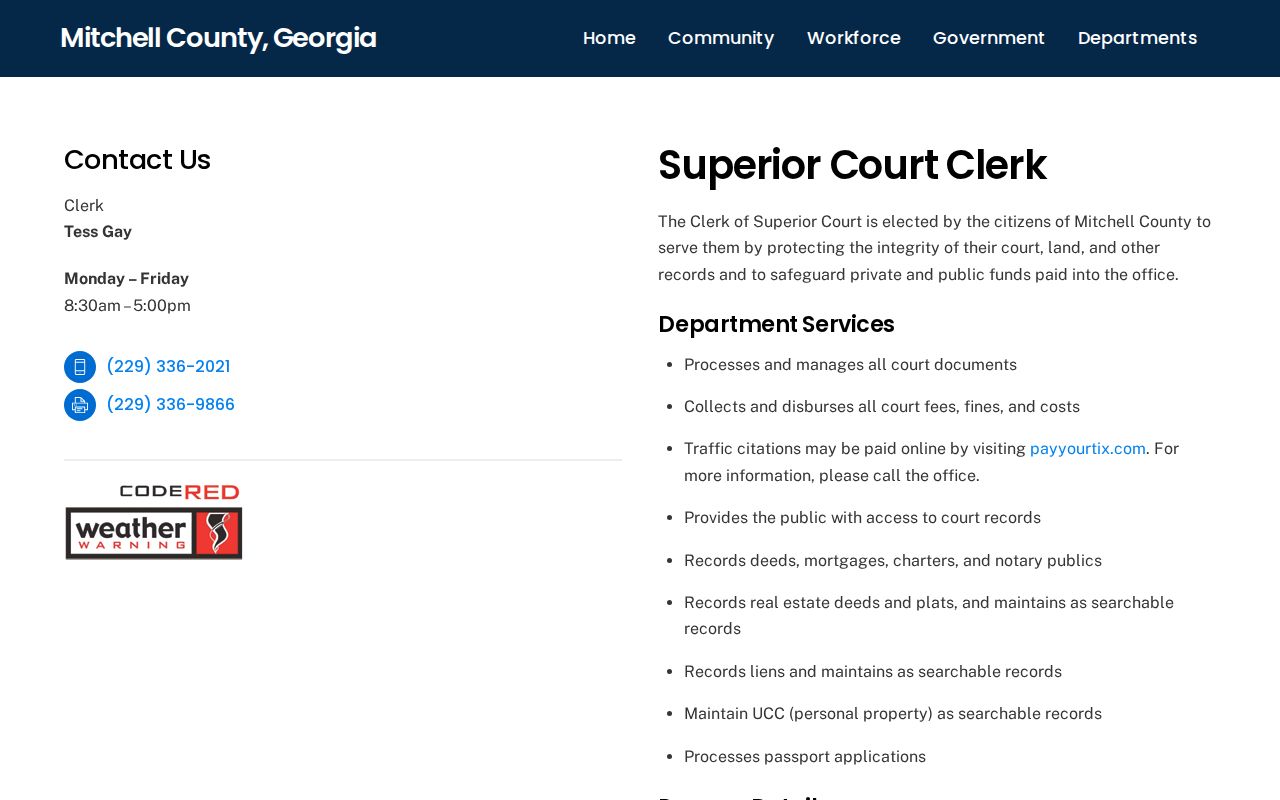
This court source helps a reader route a known Superior or State Court case without mistaking the Clerk for a countywide warrant list.
Clearing a Bench Warrant in Mitchell County
The issuing court controls recall. Confirm the order and ask what the judge requires before appearing. Local research did not find a standard Mitchell County recall form, filing fee, walk-in docket, or remote recall process. Do not invent one from another county's practice. An attorney can ask the court about a motion to recall or quash and can help plan a voluntary appearance.
- Confirm the warrant and issuing court.
- Ask counsel about recall, quash, surrender, and bond.
- Follow the court's appearance instructions.
- Resolve the missed setting or other underlying duty.
Caution: Do not arrive unannounced for an own-warrant check. Confirm the correct office and understand that an open warrant can lead to custody.
Mitchell County Traffic Warrants Differ
A missed traffic date may produce court action and a separate license consequence. Georgia's Uniform Traffic Citation warns that failure to appear can be sent to the Department of Driver Services. DDS says an FTA suspension becomes effective 28 calendar days after it receives notice. That suspension is not proof of a live bench warrant, and paying a DDS reinstatement charge does not by itself close the court case.
Read the court named on the citation. Mitchell State Court publishes courthouse and vendor payment routes, while Camilla Municipal Court has its own process. Ask the court whether a warrant issued, what resolves the missed appearance, whether it sent a release to DDS, and how to obtain the final disposition. These checks keep the court order and driver-license record from being confused.
Mitchell County Bench Warrant Fields
A court record may show the case or citation number, defendant name, date of birth or other matching detail, issuing court, issue date, alleged noncompliance, service status, bond or appearance condition, next date, and recall or disposition entry. Availability varies. A newly entered, sealed, restricted, or juvenile matter may not be visible through ordinary public access.
- Failure to appear
- A missed required court date.
- Recall
- The issuing court withdraws its warrant order.
- Quash
- A court order sets aside the warrant.
- Disposition
- The recorded result of the court matter.
Match more than a name. Similar names can point to different people, and a calendar is not a warrant list. Ask the record keeper which fields can be confirmed and which require a formal request.
Mitchell County Courts That Issue Bench Warrants
Look for the court name on the notice, citation, bond paper, or docket. Superior Court records route through the Clerk and circuit. State Court controls its misdemeanor and traffic settings. Magistrate Court handles its criminal proceedings. A Camilla, Pelham, or Sale City municipal case should begin with that city court. Baconton's reviewed source set did not reveal a municipal warrant page, so City Hall can identify whether the matter is city or county.
The sheriff is the countywide service channel, not the universal record owner. After staff identify the issuing court, direct requests and resolution questions there. A specific request under the Georgia Open Records Act process may help obtain an accessible agency record, but court rules, sealing, exemptions, and juvenile restrictions still govern what can be released.
Note: Keep the clerk's written disposition because a removed web entry alone does not establish that the court recalled a warrant.